Danielle Ariano sits at her kitchen table, alternating her attention between her laptop and a thick stack of papers. At first glance, the stack of papers, effaced by ink marks and margin comments, looks like the editorial product of a pissed-off dissertation supervisor. But such is not the case. It’s Danielle’s book manuscript in its most recent form: freshly edited (again). Though the task at hand—completing this round of edits and perhaps one more—seems daunting in both concept and observation, the reward for doing so is already in sight. The manuscript has been sold and by the end of the fall (hopefully), it will be available as an e-book on Shebooks.
When asked what made Danielle submit her manuscript to Shebooks, she said, “It seemed like it would be a good home for my book, something I would be proud to be a part of. I mean, if you’re plugged into the writing/publishing world, you probably have some kind of awareness of the ridiculous gap that exists between men and women when it comes to publishing. VIDA does this count where they look at all of the big lit journals and break down their publishing stats by gender.”
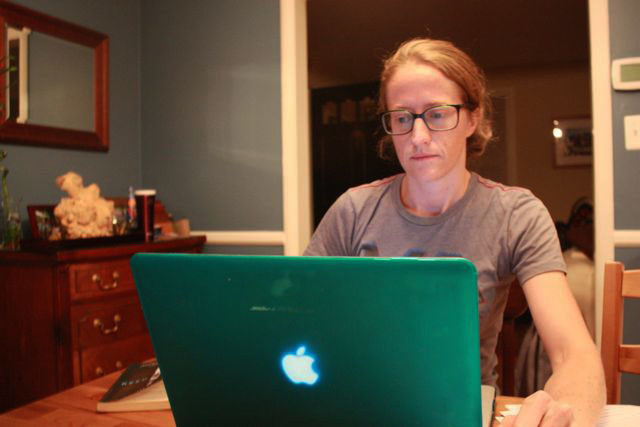
Danielle editing her book for Shebooks
VIDA – a site dedicated to promoting and exploring perceptions of women in the literary arts – indeed has several pie charts on display comparing the gender disparity present in various large literary publications. According to data collected from 2013, nearly three quarters of the bylines in The New Republic, The Nation and The Believer are male. There are even a few publications—McSweeney’s and the London Review of Books, for example—that come close to reaching the eightieth percentile mark. This means that for every female writer featured via byline in these publications, there are approximately four males featured at the same time.
It was because of gender-disparity trends like these that three women—two veterans of the digital publishing industry and one journalist—came up with the concept of Shebooks. Rachel Greenfield, Peggy Northrup and Laura Fraser had what they now refer to as their “aha!” moment at a journalism conference in 2012. While there, they were surrounded by digital publishing entrepreneurs, primarily male, blossoming in their newfound success, boasting new and innovative media formats (think along the lines of Medium.com, Forbes.com and Byliner.com) all of which were dominated content-wise by—you got it—men. Rather than stand by and wait for the perfect time in which to penetrate this online macrocosm of masculinity, they decided to create their own. Of course, their intent wasn’t to establish their own masculine realm; rather, they hoped to create a space dedicated to promoting women’s literature, for women, by women. Which is precisely what is stated on the site’s “About” page: “Shebooks is a curated collection of short e-books written by women, for women.”
Here’s how it works: Readers have two options – purchasing and downloading a single e-book for $2.99, or subscribing to the site for a monthly fee of $7.95. The latter option grants readers unlimited access to every e-book Shebooks has to offer, all of which are “novella-length” and meant to be enjoyed in only a few hours. Publishing both emerging writers and award-winning, familiar voices (such as Baltimore’s own Marion Winik, author of the Shebooks-exclusive memoir, August in Paris), the site offers e-literature in the forms of fiction, memoir, and journalism. Approximately 15 new books are published each month, designed to pique readers’ interest, warm their hearts and satiate even the most voracious of literary appetites.
Danielle Ariano’s (impending) e-book, Getting Over the Rainbow, certainly meets all of this criteria – it’s an engaging, inspiring collection of essays about Danielle’s coming out experience. “It’s a book about finding a sense of belonging,” she says, “which is an experience that most humans can relate to. Sure, maybe you didn’t start to find your sense of belonging the first time you walked over the sand dune at the lesbian beach the way that I did, but eh, that’s just the particulars of my story. What’s universal is universal.” It’s this outlook that makes Danielle’s work widely appealing.
And to have her book available on a platform that likewise sells the literary work of well-known authors improves her exposure and builds her audience. After all, there’s a universal need for more female representation in the world of digital publishing, social journalism and literary publications; it only makes sense for female writers, renowned or not, to collaborate rather than compete. Shebooks knows this; they are building their impressive library one e-book at a time. Be on the lookout for Danielle’s addition later this fall (hopefully).
Check out more lit in What Weekly here.